

When a tooth filling starts to fail, one of the first questions patients ask is, "Can you save the tooth without putting a crown on it?" The answer depends on several factors, including how much healthy tooth structure remains, where the damage is, and how much force the tooth handles every day.
At Talbert Family Dentistry, we believe in preserving as much of your natural teeth as possible. That's why Dr. Talbert carefully evaluates every tooth before recommending treatment. Sometimes an onlay is the ideal solution. Other times, a full crown provides the long-term protection your smile needs.
Knowing the difference between an onlay vs. a crown helps you better understand why your dentist recommends one treatment over the other.
Biomechanical Evaluation: The 50% Rule and Cusp Integrity
Every tooth is unique. Before recommending a restoration, Dr. Talbert performs a thorough evaluation to determine how strong the remaining tooth structure is and whether it can continue supporting everyday biting and chewing forces.
One of the biggest considerations is how much healthy tooth structure remains after removing old fillings or decay.
Assessing Remaining Healthy Tooth Structure
Large fillings can weaken a tooth over time. As they age, they may crack, leak, or allow new decay to develop underneath. Simply replacing the filling isn't always enough to restore the tooth's long-term strength.
As a general guideline, when a significant portion of the tooth has already been lost, especially more than half of the biting surface, Dr. Talbert evaluates whether the remaining tooth can safely support another filling or whether additional protection is needed.
He also carefully examines the cusps, which are the raised points on the chewing surface of your tooth. If these cusps have become thin, cracked, or weakened, they may be at greater risk of breaking during normal chewing.
Why Is an Onlay the First Line of Defense?
Whenever appropriate, preserving healthy tooth structure is the priority. Unlike a traditional crown, an onlay restores only the damaged portions of the tooth while allowing healthy enamel to remain intact. This conservative approach strengthens the tooth without removing more healthy structure than necessary.
According to the Cleveland Clinic, prosthodontic treatment focuses on restoring damaged teeth while preserving function, comfort, and long-term oral health whenever possible. That philosophy aligns closely with Dr. Talbert's approach to restorative dentistry. Rather than automatically recommending a crown, he considers whether a more conservative restoration can provide excellent long-term results.
Onlay vs. Crown: The Clinical Decision Matrix
Although onlays and crowns can both restore damaged teeth, they serve different purposes. Choosing between them depends on the condition of your tooth, not simply personal preference.
When an Onlay Is the Superior Choice (MOD Preparations)
An onlay is often an excellent option when decay or a failing filling affects multiple surfaces of a tooth, such as a mesial-occlusal-distal (MOD) restoration. Still, enough healthy tooth remains to support a partial restoration. An onlay reinforces the tooth by covering weakened cusps and preserving healthy enamel.
Research published through the National Library of Medicine (PubMed) has found that both crowns and onlays demonstrate high long-term clinical success. However, when complications occur, failures involving onlays are often less catastrophic and may be easier to repair or retreat than failures involving full crowns. For many patients, that makes an onlay an excellent balance between durability and conservative treatment.
When a Full Crown Is Historically Unavoidable
Sometimes a crown truly is the best solution. If a tooth has extensive decay, multiple large fractures, has undergone root canal treatment, or lacks enough healthy tooth structure to support an onlay safely, a crown provides complete protection by covering the entire visible portion of the tooth.
A crown also distributes biting forces more evenly, helping reduce the risk of future fractures in heavily compromised teeth. Dr. Talbert never recommends a crown simply because it's the more familiar treatment. Instead, he recommends one only when it offers the best opportunity to preserve the tooth for the long term.
Behind the Scenes: Dr. Talbert's Diagnostic Toolkit
Choosing between an onlay and a crown isn't based on guesswork. At Talbert Family Dentistry, modern technology allows Dr. Talbert to make highly informed treatment decisions while helping patients understand exactly what he's seeing.
High-Definition Intraoral Cameras 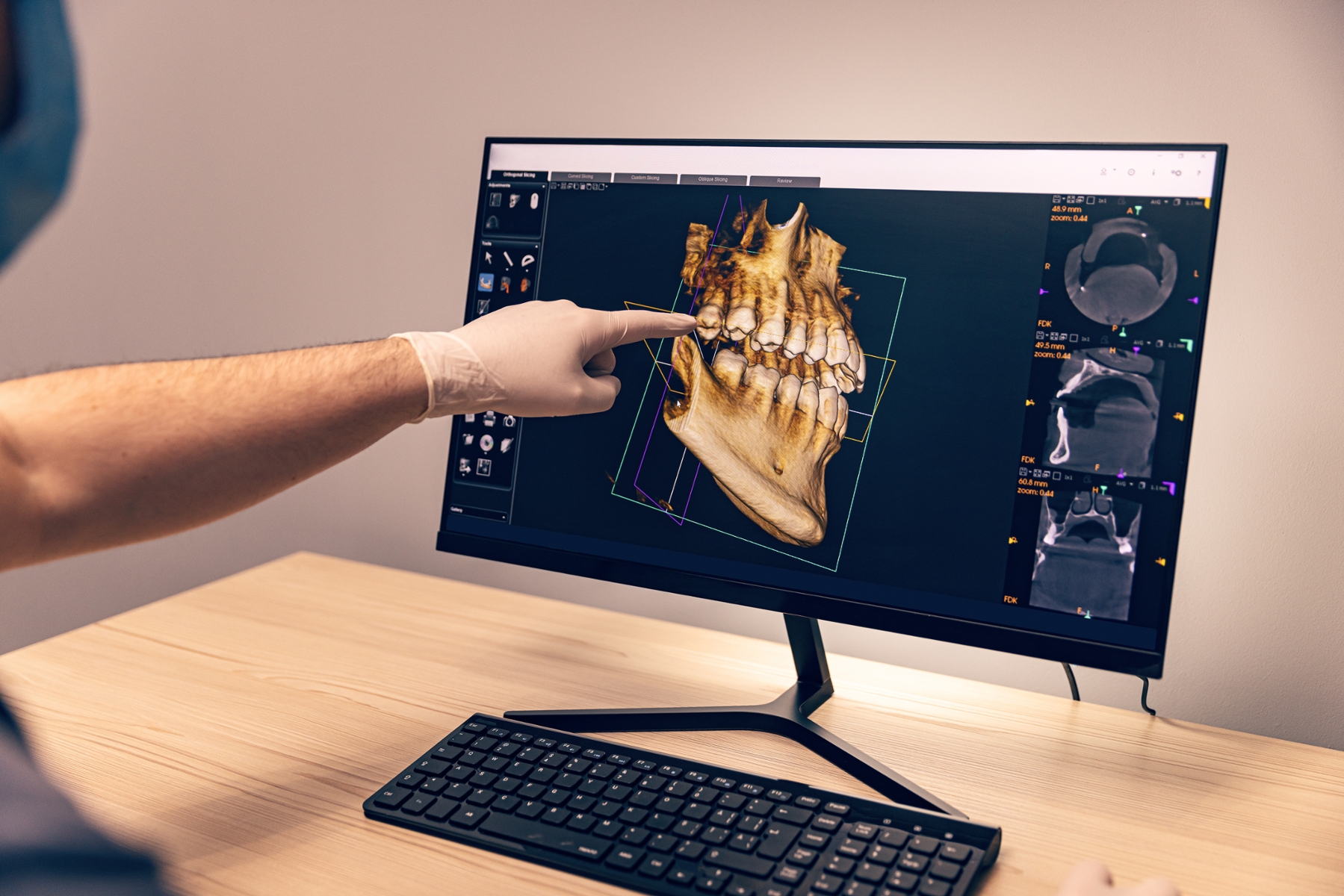
Intraoral cameras capture detailed images of your teeth that are displayed on a chairside monitor. Instead of simply hearing about a crack or failing filling, you can see it for yourself. These images help make treatment recommendations more collaborative and easier to understand.
3D Cone Beam Imaging (CBCT)
When additional detail is needed, cone beam computed tomography (CBCT) provides a three-dimensional view of your teeth, roots, jawbone, and surrounding structures. This advanced imaging allows Dr. Talbert to evaluate fractures, previous dental work, and underlying conditions that may influence the choice between an onlay and a crown.
Digital Impression Scanners and In-House 3D Printing
Gone are the days of bulky impression trays whenever possible. Digital scanners create highly accurate impressions while improving patient comfort and precision. Combined with in-house 3D printing technology, these digital workflows help streamline treatment planning and create restorations that fit comfortably and function naturally.
Personalized Restorative Dentistry in Madison, AL
At Talbert Family Dentistry, every treatment recommendation starts with one simple question: “How can we preserve your natural tooth for as long as possible?”
Sometimes that means restoring a failing filling with a conservative onlay. Other times, it means protecting a compromised tooth with a full crown. The right answer depends on careful diagnosis, advanced technology, and a personalized treatment plan. There isn’t a one-size-fits-all approach.
Life in Madison is meant to be enjoyed, from relaxing at Dublin Park to cheering on the Trash Pandas at Toyota Field, or meeting friends for dinner at Clift Farm. Your smile should be ready for it all!
Book your evaluation with Talbert Family Dentistry. Dr. Talbert will help you understand your options and recommend the most appropriate treatment to keep your smile healthy, comfortable, and strong for years to come.
Need a crown sooner rather than later? Same-day emergency crowns are also available for sudden trauma or breaks.